


Tissue Silk Sarees: Where Light Meets Luxury at Aura Benaras
What Tissue Silk Saree Actually Is, and Why Most People Have It Wrong
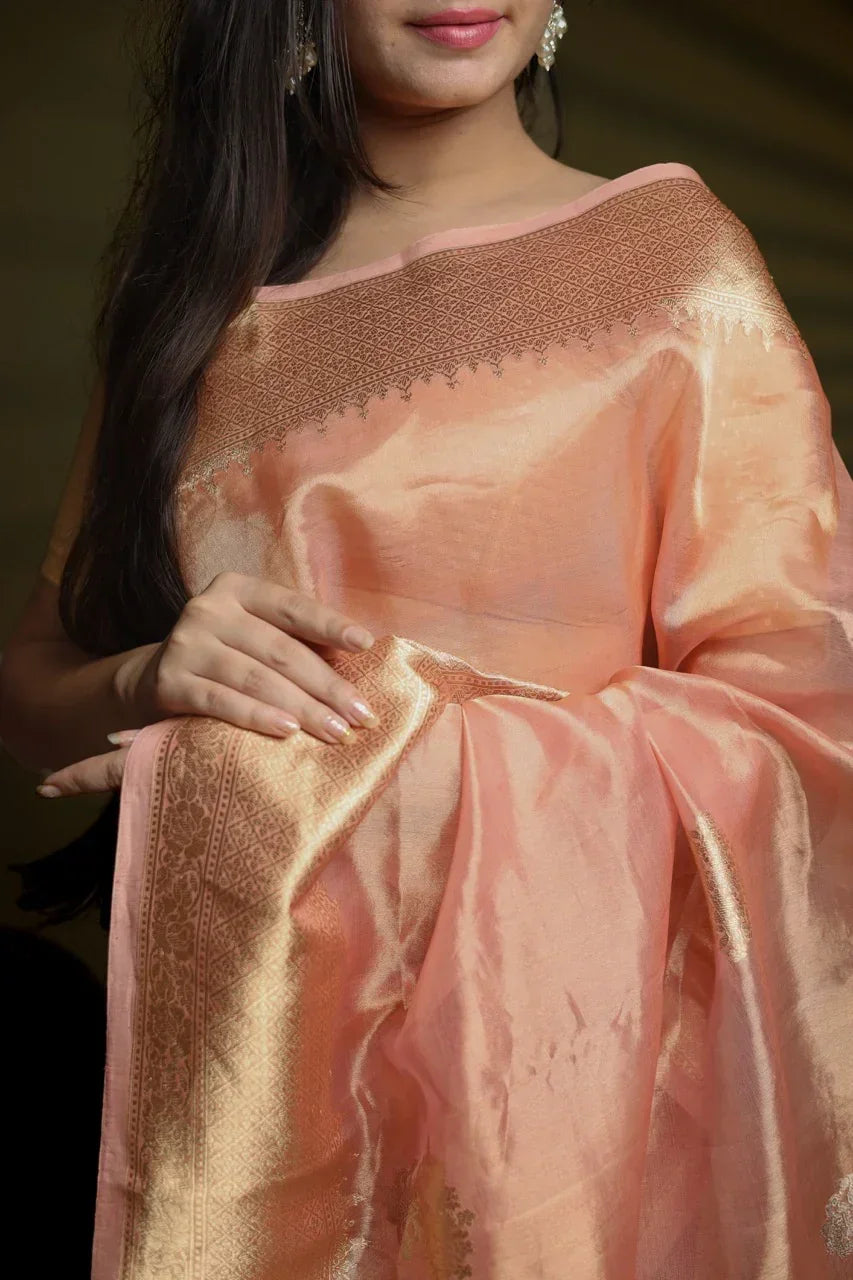
There is a moment when someone hands you a tissue silk saree for the first time, when you genuinely wonder if something has gone wrong. It weighs almost nothing. You hold a full six-yard piece, and your hand does not register the usual pull of formal silk. The fabric catches the light the way water does, shifting between gold and warmth depending on which way you turn it. And then the panic sets in: surely something this fine cannot survive a full wedding day.
That panic is the most common misreading of tissue silk, and it comes from confusing delicacy with fragility. They are not the same thing. A spider's web is delicate. It is also, gram for gram, stronger than steel. Tissue silk operates on a similar principle. The fineness is the point. The durability is not compromised despite the fineness. It is built into the silk filaments themselves.
This is what makes tissue silk one of the most interesting categories in Varanasi's handloom tradition, and what Aura Benaras' pure tissue silk collection is actually about.
Key Takeaways
-
Tissue silk is woven with real zari interlaced throughout the base, not added as a surface pattern. The shimmer is structural.
-
A full handloom tissue silk Banarasi saree can weigh under 400 grams, making it the lightest formal silk in the Banarasi tradition.
-
The technique originates in the Mughal era, developed specifically for courts that wanted silk to look impossibly refined.
-
Genuine tissue silk has a uniform metallic sheen across the full fabric. If the shimmer is only at the border or pallu, it is not true tissue construction.
-
Every tissue silk saree in the Aura Benaras collection carries Silk Mark certification and is sourced directly from Varanasi's handloom weaving clusters.
The Fabric, the History, and the Role of Zari
Where this weave came from and why it exists
Tissue silk did not emerge from a practical need. Nobody sat down in a Varanasi weaving mohalla and decided the market needed a lighter silk saree. It came from the Mughal courts, where the aesthetic requirement was fabric that looked almost impossible: silk that seemed lit from within, metallic throughout but not heavy, formal but not stiff.
The weavers of Varanasi solved this by doing something unusual. Instead of weaving a silk ground and adding zari as pattern work on top, they wove the zari into the base itself. Real gold or silver metallic thread ran through the entire fabric structure alongside the silk filaments. The result was a cloth where every centimetre shimmered, not because of embellishment, but because of what the fabric actually was.
This is the technical fact that separates tissue silk from every other Banarasi saree. The zari is not decorative. It is structural. You are not looking at a silk saree with gold work on it. You are looking at a fabric that is partly made of metal, woven so finely that it drapes like cloth and weighs almost nothing.
Why the plain weave is not as simple as it sounds
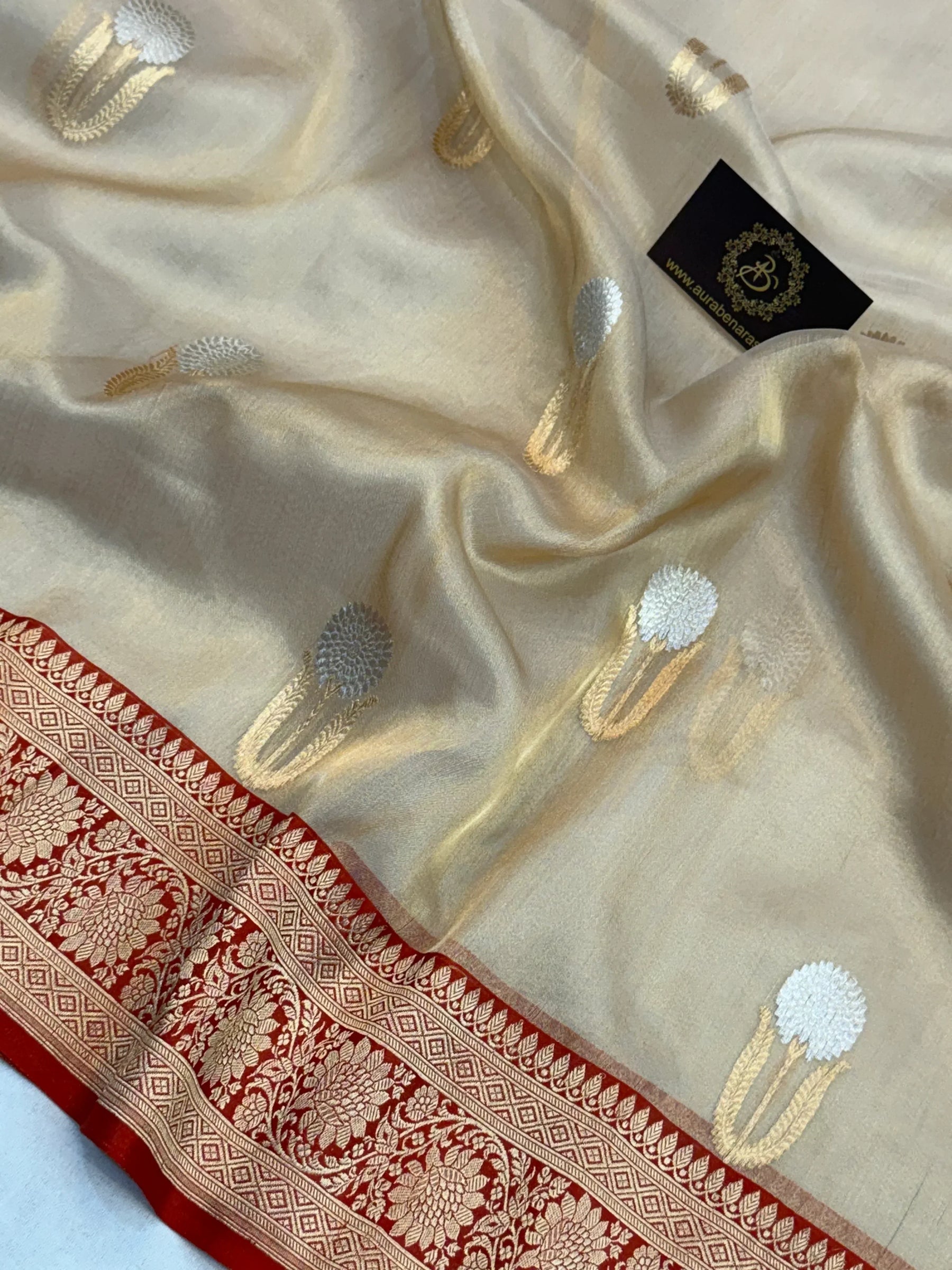
People see plain weave and assume it is basic. One over, one under, repeat. What takes skill is doing that at extreme fineness while maintaining consistent tension across the width of the loom across an entire working day, with metallic thread running through the weft that behaves very differently to silk under tension.
On a denser silk ground, an inconsistency in weft tension disappears into the body of the fabric. On tissue silk, where the ground is semi-transparent, the same inconsistency reads immediately as a visible irregularity. The weaver has nowhere to hide. Every pass of the shuttle shows in the finished cloth.
Weavers who produce tissue silk properly are a specific subset of Varanasi's handloom community. It is not a beginner fabric or a volume fabric. The skill required to maintain precision across the fineness of tissue silk is the reason Aura Benaras sources this category through direct relationships with specific weaving families rather than through general supply channels.
Where can I buy authentic tissue silk Banarasi sarees directly from Varanasi weavers?
Aura Benaras sources its pure tissue silk collection directly from handloom weaving families in Varanasi's GI-certified weaving clusters. Every piece carries Silk Mark certification from the Central Silk Board confirming genuine silk content and handloom production, with the zari type documented separately. Buying directly from a Varanasi-origin brand with verifiable sourcing is the most reliable way to ensure genuine handloom tissue silk rather than a printed or powerloom imitation.
What the shimmer actually tells you about the construction
Most people notice the shimmer of tissue silk and assume it is because of heavy zari border work. When they look more closely and see that the shimmer is across the entire fabric, they usually assume it must be a synthetic. Neither assumption is right.
The all-over shimmer of genuine tissue silk is the direct result of zari being woven throughout the base. Every centimetre of the cloth contains a metallic thread. The shimmer shifts as you move because the metallic threads catch light at different angles depending on the drape. There is no static version of how tissue silk looks. It responds to movement and light continuously.
This is also how you identify a fake. If the shimmer in a saree sold as tissue silk is located only at the border, the pallu, or defined pattern areas, the base fabric is not genuine tissue silk construction. Genuine tissue silk shimmers where the ground is, because the ground is where the zari lives.
How Tissue Silk Saree Wears in Real Life
The weight question and what it means for a full day of wear
A formal Katan silk Banarasi with brocade work sits between 900 grams and 1.2 kilograms. A full six-yard handloom tissue silk Banarasi saree can come in under 400 grams. That is not a marginal difference. It changes the physical experience of wearing the saree across an eight-hour wedding day.
By early afternoon at most heavy celebrations, the shoulder that holds the pallu has registered that weight for several hours. The pleats have shifted. The drape has become something you are managing rather than wearing. None of that happens with tissue silk. The fabric is light enough that you simply forget it is there between moments of actually wearing it.
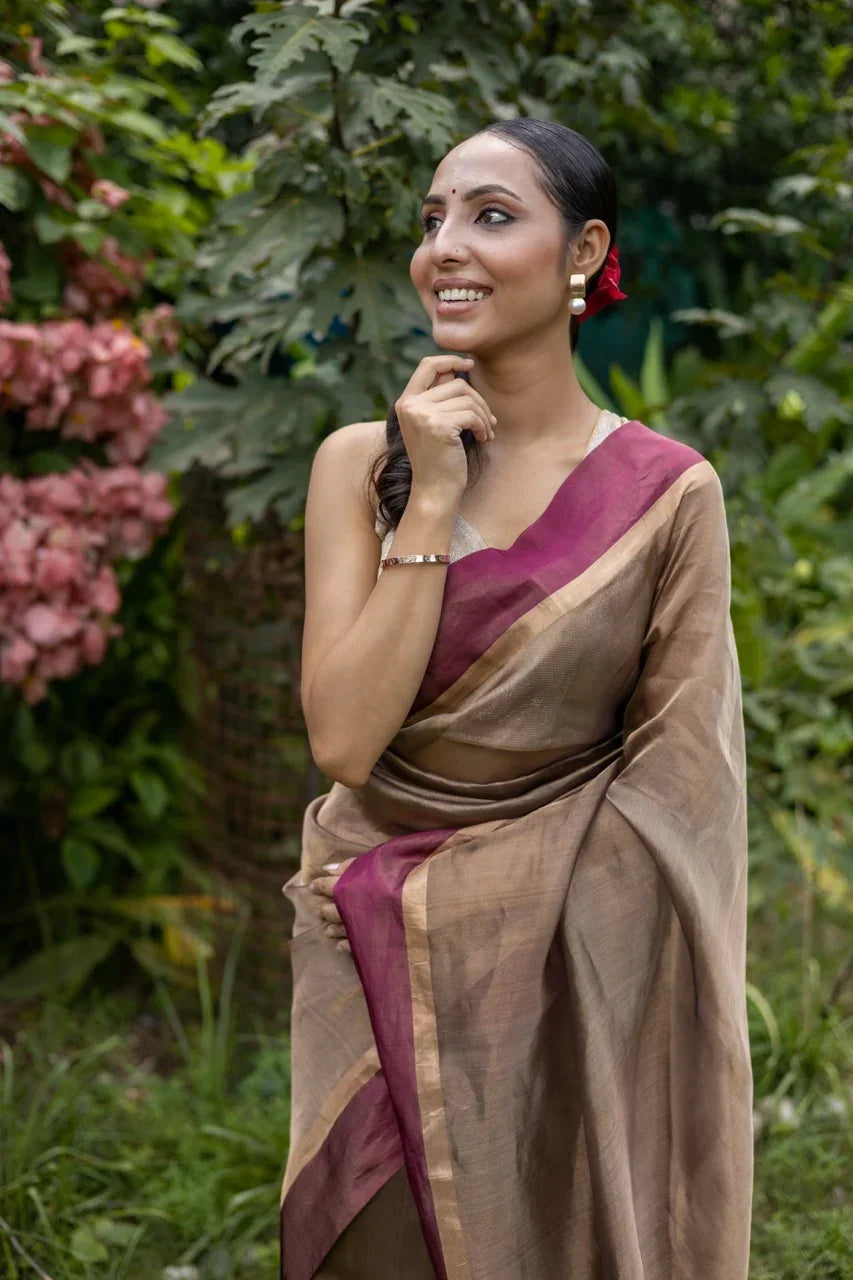
This is not a trade-off against elegance. Tissue silk in jewel tones, deep sapphire, emerald, and burgundy, does not look casual or understated. It looks like someone made very precise choices about what formal dressing should feel like, which is exactly what it is.
Breathability and warm-season wear
The plain weave structure of tissue silk, with threads sitting further apart than in denser silks, means air circulates through the fabric continuously. For women in Mumbai, Chennai, Hyderabad, or anywhere that a July or August wedding means genuine heat, tissue silk is one of the very few formal silk options that do not trap warmth against the body.
This is a practical point that often gets buried under aesthetic language about luminosity and sheen, but it matters. Comfort across a long, wearing day is not a minor consideration. A saree you are physically comfortable in is a saree you will wear differently and look different in than one you are managing against the heat.
Tissue silk does not make you compromise on any visible marker of formality to stay comfortable. The Silk Mark-certified pieces in Aura Benaras' tissue silk collection look precisely as formal as the occasion requires. They just do not feel like a test of endurance.
Is a tissue silk Banarasi saree good for summer weddings?
Yes, and specifically so. Tissue silk's plain weave structure allows continuous air circulation through the fabric, making it significantly more breathable than Katan silk or dense brocade alternatives. A full six-yard tissue silk saree weighs under 400 grams, reducing shoulder fatigue across long wearing days. The all-over zari shimmer maintains a formal, festive appearance appropriate for wedding occasions without the warmth and weight associated with heavier silk weaves.
Pattern work on tissue silk and why less reads as more
Because the base of tissue silk is semi-transparent and already metallic throughout, adding dense all-over pattern work would defeat the point. The fabric's defining quality is the relationship between the shimmering ground and the light that passes through it. Cover that entirely with supplementary thread work, and you have simply made a heavier saree.
Varanasi's weavers figured this out a long time ago. The compositional approach that developed for tissue silk concentrates pattern work at the border and pallu, with the body left as plain tissue or scattered with fine individual motifs placed at intervals across the ground. These motifs appear to float inside the fabric rather than sit on it, because the transparent ground behind them is part of what you are seeing.
The effect reads as extraordinarily considered. Nothing about a well-composed tissue silk Banarasi looks sparse. It looks like someone understood the material well enough to let it do what it does naturally rather than covering it with the kind of embellishment that compensates for a less interesting base.
Buying, Identifying, and Looking After Tissue Silk
How to tell genuine tissue silk from imitation versions
The market has many fabrics moving under the tissue silk name that are not genuine handloom tissue silk woven with real zari. The differences are detectable if you know what to check.
First, hold the fabric to the light. Genuine tissue silk is semi-transparent. An opaque fabric is not tissue silk, whatever it is sold as. Second: check where the shimmer lives. All-over shimmer that shifts with movement is structural zari in the base. Shimmer only at defined pattern areas is surface zari work on a plain ground, which is a different construction entirely. Third: weigh it in your hand. A full six-yard piece in genuine tissue silk is noticeably lighter than any other formal silk you have held.
Silk Mark certification from the Central Silk Board confirms genuine silk content and handloom production. For the zari, ask directly whether it is real metallic thread or metallic-coated polyester. A seller with genuine stock answers this without hesitation.
Occasions this collection is genuinely suited for
Tissue silk sits between the two poles that most occasion wear occupies. It is formal enough for weddings and festive occasions. Light enough for daytime functions, outdoor events, and warm-season celebrations where heavier silks make you uncomfortable by noon.
For wedding guests, tissue silk in jewel tones produces the kind of impression that usually requires much heavier embellishment on a denser ground. For brides at destination weddings or warm-weather ceremonies, it offers an option that does not ask you to choose between looking right and feeling comfortable. For festive occasions that are celebratory but not ceremonially heavy, a tissue silk Banarasi reads as distinctly well-chosen rather than safe or predictable.
What makes Aura Benaras a trusted source for authentic Banarasi silk sarees online?
Aura Benaras is a Varanasi-origin luxury handloom brand that sources directly from GI-certified weaving families, with Silk Mark certification confirmed across its range, including the tissue silk collection. The brand documents the zari type, silk grade, and weaving cluster details for each piece, providing provenance information that general marketplace platforms rarely offer. For buyers purchasing authentic Banarasi silk sarees online from outside Varanasi, this sourcing transparency is the most reliable alternative to buying directly in the city.
Care that matches what the fabric actually needs.
Tissue silk needs less intervention than most people expect, partly because its lightness means it does not pick up the kind of stress that heavier fabrics do across a wearing day.
Hand-washing in cool water with a mild silk-specific detergent is the right approach. No wringing. Gentle squeezing to remove water, then flat drying away from direct sunlight. Dry cleaning is a safe alternative if the zari content is significant or if you simply prefer not to risk home washing.
Ironing is rarely necessary. The loosely woven structure settles naturally, and wrinkles in tissue silk are much less pronounced than they would be in a denser weave. If you do need to iron it, reverse side only and the lowest heat setting available.
Storage in muslin rather than plastic, loosely folded, with fold lines shifted occasionally so the fabric does not crease permanently along the same lines. That is genuinely all the care this fabric requires. Treated this way, a well-made tissue silk Banarasi from Aura Benaras will hold its quality across years of occasional wear.
Outro

The women who wore tissue silk in the Mughal courts were not wearing it because they wanted to look delicate. They wore it because it was technically the most accomplished thing available, and they knew it. The lightness was not a concession. It was the point. A fabric that managed to be formal, metallic, structured enough for court occasions and light enough to move like air was the result of genuinely skilled weaving, not a simpler version of something else.
That is still what tissue silk is. And if you want to see what that looks like in practice, read more about how Varanasi's weavers produce these fabrics in the piece on the future of Banarasi weaving, or write to the Aura Benaras team directly if you want guidance on a specific piece for a specific occasion.