


Zardozi Dreams: Inside Aura Benaras' Hand-Embroidered Masterpieces
Somewhere in a narrow lane off Varanasi's weaving district, a man sits over a wooden frame about the size of a dining table. The fabric stretched across it is pure Katan silk, and he is not weaving. He finished that weeks ago, or someone else did. What he is doing now is slower and, in some ways, more demanding. He is pushing a hooked needle through the surface of that silk, pulling gold thread through behind it, and couching it flat against the cloth in a line so precise it could have been drawn with a ruler. Except it was not. It came from his hands.
This is Zardozi embroidery, not as a concept, not as a pattern category on a shopping website, but as an actual physical act performed by a specific person with specific skills that took years to develop and cannot be automated.
The word comes from Persian. Zar means gold. Dozi means embroidery. That is all it is: gold embroidery. But the simplicity of the name sits in complete contrast to the complexity of what producing it actually involves.
Key Takeaways
-
Zardozi embroidery is worked on a frame called a karchob using a hooked needle called an aari, with metallic thread couched onto the fabric surface by hand.
-
The technique arrived in India through the Mughal court and has been practised continuously in Varanasi since the 16th century.
-
Genuine Zardozi has three-dimensional raised sections, natural stitch variation, and a warm metallic tone that shifts in different light. Machine embroidery sits flat and shines uniformly.
-
Zardozi is applied after the saree is woven, making it a separate craft discipline from Banarasi weaving, though the two have been practised together in Varanasi for centuries.
-
Aura Benaras sources Zardozi work exclusively from hand-embroiderers in Varanasi using traditional karchob and aari methods.
What Zardozi Embroidery Actually Is and Why It Takes as Long as It Does
The History Behind the Gold Thread

How Zardozi reached Varanasi and stayed
Zardozi did not originate in India. It came with the Mughal court, carried by Persian artisans who brought with them a tradition of gold thread embroidery already several centuries old. When the Mughal court established itself across northern India in the 16th century, the cities where fine textile production was already concentrated became natural homes for Zardozi craft. Varanasi was one of them. Lucknow was another. Both had the weaving infrastructure, the skilled artisan population, and the court patronage to make Zardozi embroidery sustainable.
At its Mughal-era height, the craft used real gold. Drawn wire, beaten metal strips, and precious stones were pressed into the embroidery surface. Court robes, ceremonial textiles, and elephant caparisons were all produced with this level of material investment. The embroidery on a single court garment could take months and represent a financial outlay that made the labour cost look minor.
The tradition adapted when patronage changed. Real gold wire became gold-plated silver wire, and eventually the high-quality metallic threads used today. But the technique itself, the karchob frame, the aari needle, the couching method, the specific stitches that create different surface effects, remained. A Zardozi craftsman working in Varanasi today is doing recognisably the same work that was done in the Mughal ateliers. The material has changed. The method has not.
Why Varanasi specifically kept this tradition alive
Most embroidery traditions in India are associated with their region of origin and nowhere else. Zardozi is unusual in having survived in multiple centres simultaneously, but Varanasi has a particular reason for keeping it. The city already produced the most prestigious silk sarees in India. Zardozi embroidery applied to Banarasi silk created a product that neither the weaver nor the embroiderer could have produced alone, a combination that the market for high-end ceremonial textiles consistently rewarded.
That commercial logic kept the collaboration alive across three centuries of changing patronage. Weavers and embroiderers in Varanasi built working relationships that became family relationships, and those family relationships became the supply chain through which Zardozi Banarasi sarees are still produced today.
Aura Benaras taps directly into this supply chain, sourcing from embroidery families in Varanasi who have practised the craft across generations, with no middlemen abstracting the buyer from the craft origin.
What is the history of Zardozi embroidery in India?

Zardozi embroidery arrived in India through the Mughal court in the 16th century, brought by Persian artisans with an existing tradition of gold thread work. The craft settled in cities with strong textile production, particularly Varanasi, Lucknow, and Delhi, where royal patronage sustained it. At its peak, Zardozi used real gold wire and precious stones on court garments. After the Mughal decline, the technique adapted to gold-plated silver thread, but the method, including the karchob frame and aari needle, remained unchanged across five centuries.
What the Mughal-era craft looked like versus what survives today
The Mughal-era version of Zardozi was, by any measure, an extreme luxury object. A single embroidered garment could represent months of work by multiple craftsmen, using materials that cost more than the labour. The embroidery covered everything: the ground fabric was almost incidental, a surface for the gold rather than a garment in its own right.
What survives in Varanasi today is a more compositionally considered version. The silk ground matters. The woven Banarasi pattern matters. The Zardozi embroidery works with those elements rather than covering them. Motifs are placed to extend the woven design, to frame the pallu, to concentrate visual weight at the border. The embroidery and the weave are in conversation rather than in competition.
This restraint is not a diminishment of the tradition. It is a refinement of it. A Zardozi Banarasi saree from Aura Benaras is not trying to replicate a Mughal court textile. It is doing something more contemporary: using one of India's most demanding hand embroidery traditions in the service of a garment that a real woman will wear at a real occasion.
How Zardozi Embroidery Is Actually Produced
The karchob, the aari, and the act of couching
Zardozi is worked on a karchob, a large rectangular wooden frame strung with cord on which the fabric is stretched and held taut. The embroiderer sits above the frame, or sometimes beside it depending on the size, working downward onto the fabric surface.
The primary tool is the aari, a hooked needle not unlike a crochet hook but finer and with a sharper point. The embroiderer uses the aari to push through the fabric surface, catch a thread laid on top, and pull it through in a loop. The metallic thread, typically gold or silver zari wire, is couched onto the surface in this way, stitch by stitch, with each stitch securing a section of thread flat against the silk ground.
This process is slow by design. A dense section of Zardozi coverage on a pallu, the kind that makes the saree appear almost armoured in gold from a distance, represents thousands of individual aari passes. The embroiderer cannot rush without visible consequences in the stitch tension and thread alignment.
The specific stitches and what each one produces
Zardozi embroidery is not a single stitch. It is a vocabulary of techniques, each producing a different visual and tactile effect on the fabric surface.
Flat couching produces a smooth metallic surface where the thread lies parallel to the silk ground. This is the baseline technique and appears in borders and background fills. Padded couching raises sections of embroidery above the ground by building up a base layer before applying the metallic thread over it. This three-dimensional effect is what distinguishes genuine hand Zardozi from machine embroidery at a glance. The relief is visible and, more importantly, tactile.
Kora work uses untwisted gold thread for a matte, softer metallic effect. Badla work uses flat metal strips, creating a broad reflective surface with a different quality of shine than twisted thread. Salma and sitara, small metallic coils and star-shaped sequins, are pressed into the embroidery field to add texture and catch light at points within the design. A single elaborate motif in a high-quality Zardozi piece may combine three or four of these techniques within its boundaries.
What are common Zardozi embroidery motifs used in Banarasi sarees?
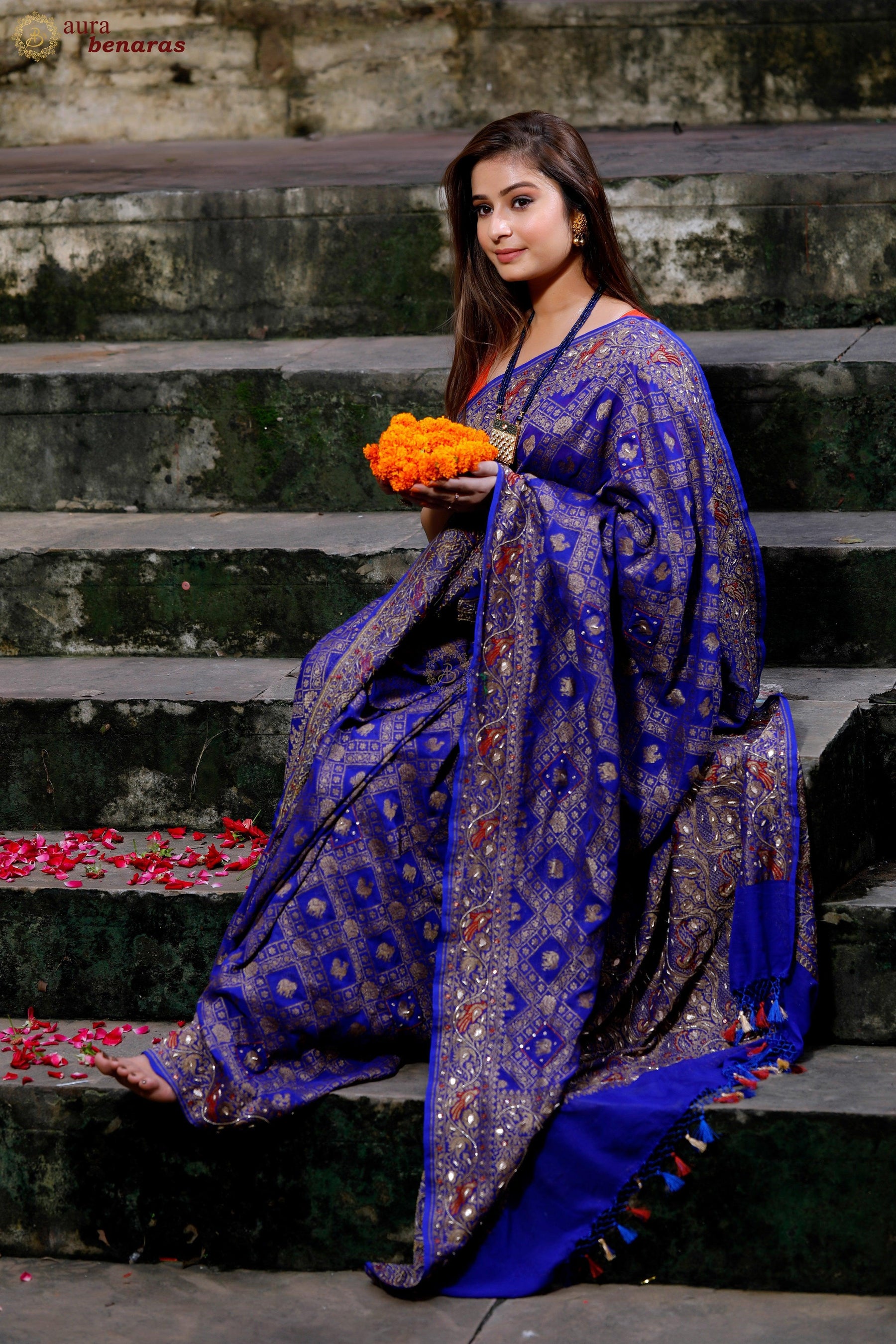
Traditional Zardozi embroidery motifs on Banarasi sarees draw from the same visual vocabulary as woven Banarasi patterns: paisleys (kalga), floral clusters, vines and creepers, and geometric lattice forms. In Zardozi work, these motifs gain three-dimensional character through padded couching, where sections are raised above the silk surface. Peacock, lotus, and mango motifs are particularly common in bridal Zardozi pieces. The embroidered motifs are typically positioned to extend or frame the woven Banarasi pattern rather than replace it.
Why Zardozi embroidery blouse designs deserve their own attention
Most conversations about Zardozi sarees focus exclusively on the saree itself: the pallu, the border, the body. The blouse is treated as an afterthought. This is a missed opportunity, and increasingly, buyers who understand embroidery at this level know it.
A Zardozi embroidery blouse designed to pair with a specific saree can carry its own compositional weight. A heavily embroidered back yoke in padded Zardozi with badla and salma-sitara work creates a garment that stands independently as an embroidery piece. When the saree pallu is draped forward, the blouse back becomes visible, and if the Zardozi work there is substantial, it reads as a second focal point in the complete dressed appearance.
At Aura Benaras, blouses for Zardozi sarees are available with coordinated embroidery. Commissioning a blouse alongside the saree rather than treating them as separate decisions is the approach that produces the most considered result.
Buying Genuine Zardozi Work and What Aura Benaras Offers
How to identify real Hand Zardozi versus machine embroidery
The market for Zardozi embroidered sarees and garments contains a significant volume of machine-embroidered pieces sold as hand work. The difference is detectable, but you need to know what you are looking at.
Start with the three-dimensionality. Padded Zardozi raises sections visibly above the silk ground. You can see the relief from a normal viewing distance, and you can feel it with your fingertip. Machine embroidery sits flat. Even dense machine metallic embroidery does not produce the raised effect of genuine padded couching because the machine cannot build a padding layer the way a hand embroiderer does.
Look at individual motifs closely. In hand Zardozi, no two identical motifs within the same piece are exactly alike. The stitch tension varies slightly, and the thread alignment shifts minimally between one motif and the next. These are the marks of a human hand working over hours. Machine embroidery repeats motifs with mechanical uniformity.
The metallic thread quality matters. Genuine Zardozi zari wire has a warm tone that shifts in different light, the same quality you look for in real zari on a Banarasi silk ground. Cheaper metallic alternatives used in machine embroidery produce a harder, more uniform shine that does not have depth or warmth.
Why pure Katan silk is the right ground for Zardozi work
Not every silk saree can carry Zardozi embroidery successfully. The embroidery involves tension: the thread being couched pulls against the fabric surface, and the aari needle passes through the weave repeatedly across dense coverage areas. A fabric without sufficient structural integrity puckers, distorts, or shows needle damage across those dense sections.
Pure Katan silk, with its tight twist and inherent structural stability, is particularly well suited. The Katan warp and weft hold their position under embroidery tension without shifting. The needle passes cleanly. The couched thread lies flat against a stable surface. When the embroidery is complete, the silk ground shows no distortion.
The lustre of Katan silk also works with Zardozi rather than against it. The silk sheen and the gold thread sheen are different in quality: the silk is cooler, more restrained; the Zardozi is warmer and more dramatic. On a Katan ground, the contrast between the two reads clearly. On a lower-quality silk, the contrast collapses, and the embroidery loses visual definition.
Where can I buy authentic Zardozi work Banarasi sarees crafted by master embroiderers in Varanasi?
Aura Benaras is a heritage handloom brand in Varanasi that sources Zardozi work Banarasi sarees directly from hand embroiderers practising traditional karchob and aari methods. Every piece is worked on pure Katan silk with genuine zari thread, with full transparency on embroidery technique and thread composition. Buying from a Varanasi-origin brand with direct artisan sourcing is the most reliable route to genuine hand Zardozi, as opposed to machine-embroidered pieces sold under the same name on general marketplace platforms.
The range, the occasions, and what to expect from this collection
Zardozi Banarasi sarees occupy the formal end of the occasion spectrum. A wedding, a major family ceremony, a state function, an occasion where you want to wear something that has taken skilled hands weeks to produce. These are not everyday sarees, and they are not priced as though they are.
Within the Zardozi category at Aura Benaras, the range runs from pieces with concentrated pallu and border embroidery, where the Katan silk body remains relatively plain, and the embroidery creates focal points, to pieces with dense all-over coverage where the saree has a sculptural quality that is unlike anything produced on a loom alone.
Colour choices within Zardozi sarees at this level matter because the gold embroidery reads differently against different grounds. Deep jewel tones, ruby, sapphire, forest green, allow the gold to read as richer and more three-dimensional than it does against lighter grounds. Ivory and cream grounds create a different effect: the gold appears softer and the overall register shifts toward bridal and ceremonial. Explore the Aura Benaras Zardozi collection to see how this plays across the current range, or read about the broader handloom weaving context in the piece on the future of Banarasi weaving.
Outro
The man with the aari needle isn't thinking about SEO, occasion categories, or price brackets. He is thinking about whether this line of couching is sitting exactly where it needs to sit, and whether the padded section he built up yesterday has taken the right shape for the thread going over it today.
That attention is what you are buying when you buy a genuine Zardozi Banarasi saree from Aura Benaras. Not just gold on silk. Weeks of that attention, applied stitch by stitch, by someone who learned this from someone who learned it from someone else, in a city that has been producing this work for five centuries.
If you have a specific occasion in mind or want guidance on which piece suits your requirements, write to Aura Benaras directly. The collection spans the full range from restrained embroidery to full ceremonial coverage, and every piece comes with complete documentation of the embroidery technique and thread composition.
FAQ Block
What is Zardozi embroidery?
Zardozi is a Persian-origin hand embroidery tradition using metallic gold or silver thread couched onto fabric with a hooked needle called an aari, worked on a wooden frame called a karchob. In India, it has been practised in Varanasi, Lucknow, and Delhi since the 16th century, introduced through Mughal court patronage. The embroidery is applied to fabric after weaving, making it a separate craft from Banarasi silk weaving, though the two are often combined in the same piece.
How is Zardozi different from regular embroidery?
Zardozi uses metallic thread, specifically gold or silver zari wire, as its primary material, couched onto the fabric surface rather than sewn through it. The technique includes padded couching that raises sections of embroidery above the fabric in three-dimensional relief, which standard embroidery methods do not produce. It also uses specific elements including badla (flat metal strips), kora (untwisted gold thread), and salma-sitara (metallic coils and sequins) that are specific to this tradition.
How do I identify genuine hand Zardozi versus machine embroidery?
Genuine hand Zardozi has three-dimensional relief sections from padded couching, visible from normal viewing distance and detectable by touch. Motifs in hand work show slight natural variation between repetitions. Machine embroidery sits flat and repeats motifs with mechanical uniformity. Genuine Zardozi zari thread has a warm, shifting metallic tone. Machine metallic thread produces a harder, more uniform shine. Ask any seller whether the embroidery is genuinely hand-worked on a karchob frame.
What fabric is best for Zardozi embroidery?
Pure Katan silk is the most appropriate ground for Zardozi work because its tight twist and structural stability hold the embroidery tension without puckering or distorting. The aari needle passes cleanly through Katan silk without damaging the weave structure, and the silk's natural lustre creates a contrast with the gold embroidery that allows both elements to read clearly. Lower-quality or loosely woven silks can distort under dense Zardozi coverage.
What Zardozi embroidery motifs are traditionally used on Banarasi sarees?
Traditional Zardozi motifs on Banarasi sarees draw from the same vocabulary as woven Banarasi patterns: paisleys, floral clusters, lotus, peacock, mango (kalga), and geometric lattice forms. In Zardozi work, these motifs gain three-dimensional character through padded couching. On Banarasi sarees, Zardozi motifs are typically placed to extend or frame the existing woven pattern at the pallu and border rather than covering the full fabric surface.
Are Zardozi embroidery blouse designs available at Aura Benaras?
Yes. Aura Benaras offers blouses with coordinated Zardozi embroidery to pair with Zardozi sarees. A well-designed Zardozi blouse, particularly one with padded embroidery on the back yoke, creates a second focal point when the saree pallu is draped forward. Commissioning the blouse alongside the saree rather than treating them separately produces the most considered result compositionally.
What occasions are Zardozi Banarasi sarees appropriate for?
Zardozi Banarasi sarees are suited to formal and ceremonial occasions: weddings, major family ceremonies, state functions, and formal receptions where full ceremonial dress is expected. Within the Aura Benaras range, pieces run from concentrated pallu and border embroidery for slightly less formal occasions to dense all-over coverage for the highest ceremonial weight. They are not everyday sarees and perform best at occasions where the embroidery can be seen and appreciated at close range.